
What Do We Need From Each Other? Maslow in Relationships
A run-of-the-mill Tuesday night. One partner comes home exhausted, the other wants to talk about why they have felt distant lately. Within ten minutes, they are arguing about tone, dishes, and who cares more. Does that sound familiar?
The dishes can wait.
Someone needs sleep (maybe they both do). Someone else needs reassurance, and neither can find a way to say what they need without making the other person feel defensive.
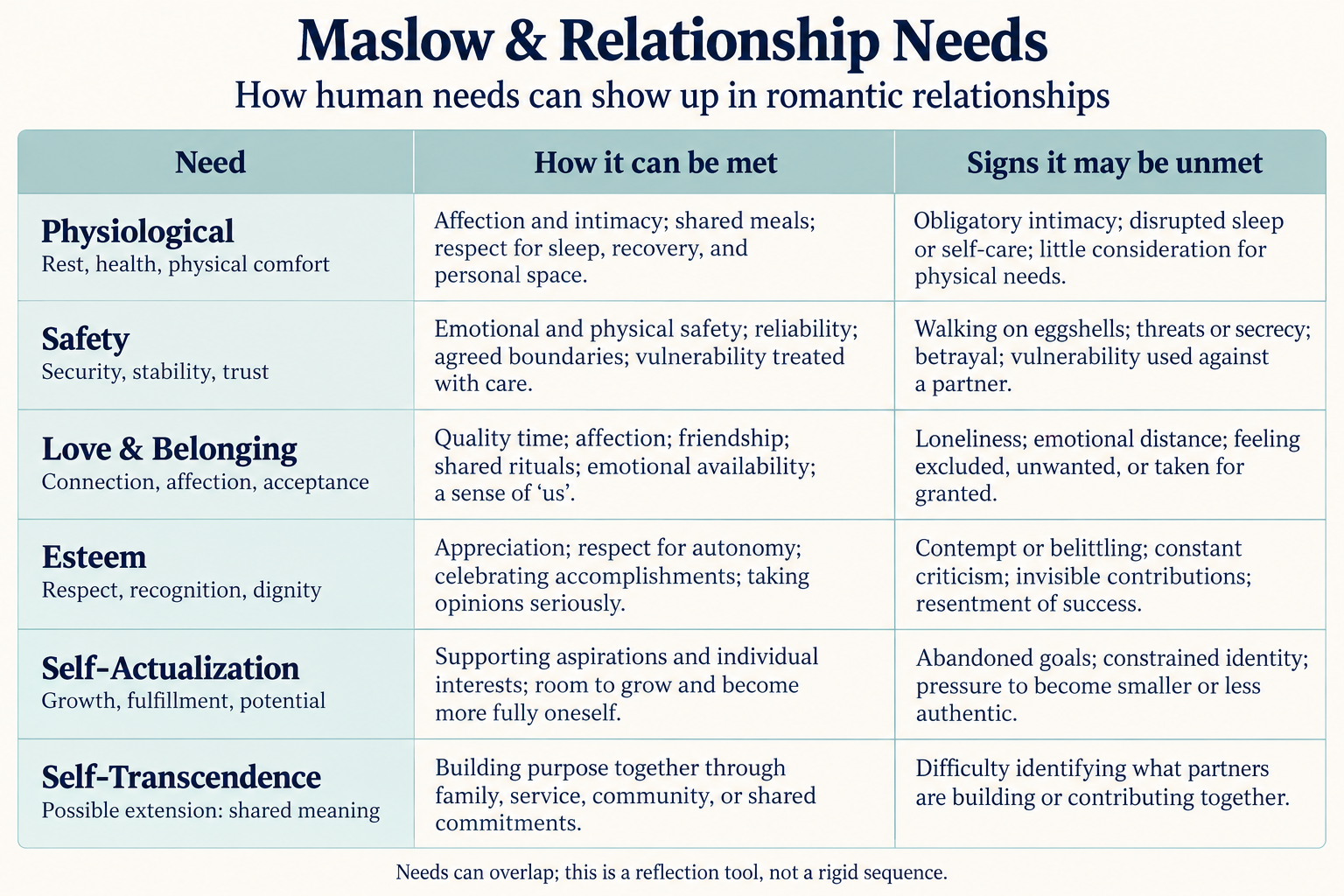
Abraham Maslow’s theory of human motivation offers a useful starting point for understanding these moments. His original framework described physiological needs, safety, love and belonging, esteem, and self-actualization - these needs overlap (Maslow, 1943). Using it as a basic proxy for how humans function, it can be helpful to all human interaction… but let’s apply it to romantic relationships.
The framework provides an opportunity to reflect on what daily life actually feels like. It might feel like what the relationship needs is a fancy getaway to a beach somewhere - but could the actual need be more simple?
Start With the Body
It is difficult to be generous when you are exhausted, hungry, or in pain. That does not excuse rude behavior, of course. But it does give couples something practical to consider before interpreting every difficult interaction as evidence of a failing relationship.
First, check in on physical state. If your partner works an early shift, but you keep Netflix blaring until midnight, you’re sending a signal about whose comfort matters. So does expecting an emotionally demanding conversation when they have barely slept… even if the issue deserves attention and your frustration makes sense.
Care doesn’t have to appear in grand gestures. It can take the shape of making dinner when your partner is depleted, protecting time for exercise (for you, or them), or just leaning in for a hug - small gestures can (and should) go a long way. One of those small gestures, if physical state is challenged, might be the patient allowance of time. “Take your time, we can chat later” can be a meaningful demonstration.
Imagine the amount of difficult conversations that could have been eased - not eliminated, but eased - by getting some rest, or having a snack.
Can I Be Honest?
Safety is especially important during disagreement. Can you tell your partner something they do not want to hear without expecting humiliation, retaliation, or a threat to end the relationship?
Imagine admitting that you feel insecure about your career. Two weeks later, during an unrelated argument, your partner throws that conversation back at you. The original conversation may have felt supportive. Now you have a reason to protect vulnerabilities, or avoid them altogether.
Financial secrecy can create similar uncertainty. So can unpredictable anger. Reliability grows through specific actions, including honoring agreed boundaries and returning to a conversation when you said you would.
Or maybe one partner speaks in polarizing language like “always” and “never” - “you always think of yourself first” or “you never clean up after yourself.” Small missteps can be pushed to their polar extreme and serve as indictments of character.
The way we talk to each other matters… especially when other people are listening. A joke about someone’s incompetence may get a laugh at a party. The person being described still has to go home with you. Pay attention to those moments.
Constant correction can make an adult feel supervised in their own home. This doesn’t mean you can’t talk about things in your relationship (or work, or home) you’d like to change, but it does mean you have to be conscious of how those messages are delivered, and how they land.
A relationship can contain disagreement and still feel safe. But not if speaking honestly carries a price that one person has learned to fear.
Appreciation works best when it’s authentic - notice how patiently your partner handled a difficult conversation, that’s better than a vague compliment. But don’t forget to also notice the small but meaningful things they they do for you, or for the home, every day. Shine a light on each other’s efforts, even if they are subtle.
Respect and Belonging
Sharing an apartment does not guarantee a sense of belonging. You can sit beside someone every evening and still feel that their attention is somewhere else.
Imagine a dinner conversation where one person starts describing something that happened at work while the other keeps scrolling on their phone, occasionally offering a distracted acknowledgment. This is way too common. Repeated often enough, that small exchange can become the clearest account of how the relationship feels; a visual signal that the other person is not the top priority.
It sounds obvious. But why do we keep doing it?
Belonging might develop through a walk after dinner, or a familiar greeting at the door. Each activity can be experienced as an invitation to connect - it’s an effect that compounds. In these small efforts, keep tuning in to your partner. A scheduled date night accomplishes little if one partner spends it feeling “tolerated” rather than appreciated.
Ask when your partner feels close to you. Share in return. Get clear on what makes each person feel appreciate - empathy, to a degree, has to be made practical.
Room to Become Yourself
Maslow described self-actualization as the desire to realize one’s potential (Maslow, 1943). In a relationship, people often report wondering if a shared life gives each partner room to develop. A fair question. Committed relationships should include two people living as themselves, for each other.
Maybe your partner wants to return to school. Tuition would strain the budget, and evening classes would change the household routine. Those concerns deserve a serious conversation. Dismissing the idea because their ambition makes you uncomfortable deserves a different kind of attention. Be honest about where discomfort comes from. Growth might feel like an inconvenience, but it’s essential.
Supporting it (in this case) requires honest discussion about costs and responsibilities. It also requires recognizing that preserving the current arrangement is not automatically the fairest choice. Feelings matter. Logistics matter. Both partners should have a voice in the decision, and neither should have to surrender an important part of themselves simply to keep the peace.
As the comedian/philosopher Jimmy Carr says, “we [mistakenly] think that our partner should be our everything… but actually, we do much better when we’ve got our own life, and they add to it, rather than ‘completing’ us.”
Let your partner go on a run, go get a drink with their friends, or go read a book at the coffee shop alone. You should feel comfortable doing the same. Living as oneself should not be a threat to the relationship.
What Are We Building?
Maslow's later thinking included self-transcendence, extending attention beyond personal fulfillment toward purposes outside oneself (Koltko-Rivera, 2006). For couples, this raises another question: “What do we want our shared life to look like?” and, importantly, “Does our behavior match our goal?”
The answer can be anything, as long as it’s honest. Perhaps you want to raise children who feel safe asking difficult questions, or create a home where friends know they can come when life gets rough.
Purpose takes repeated action. It is built the same way any of the needs here are met - not through one grand decision, but through what you choose to do today, or this week.
During one conversation this week, ask where your partner feels supported and when/if they feel alone. Listen long enough to hear an example. Don’t get defensive, just listen. Then identify something you can actually change, whether that means putting down your phone at dinner or keeping a promise you have repeatedly postponed.
Stay curious. Stay thoughtful. Keep coming back to the table and set the stage for meaningful conversation. Along the way, put a Maslow-lens on the situation… if your best efforts to connect are being missed, you might just need to sleep on it.
References
Koltko-Rivera, M. E. (2006). Rediscovering the later version of Maslow’s hierarchy of needs: Self-transcendence and opportunities for theory, research, and unification. Review of General Psychology, 10(4), 302–317.
Maslow, A. H. (1943). A theory of human motivation. Psychological Review, 50(4), 370–396.