
Keys to Optimism (and Why It Matters)
Olympic-caliber skiers, often in the backcountry, know the importance of focusing on the path rather than the trees. When a market shifts, successful CEOs pivot around it. Rather than dwelling on issues that are not going to plan, rigid within previous expectations, they focus on opportunities. They find an open path.
This is important for all of us to understand, since we have a shared tendency to prove ourselves right. We find what we're looking for. If you think a workday is going to be boring, then every slow moment will be proof of that idea. But if you believe the day might be interesting, you will have created a magnetism for the interesting ideas that may pop up along the way. It does not mean everything will be perfect.
Optimism is one of the most powerful mindsets one can adopt. But a specific sort of optimism works best. We call it optimistic realism. It's not the same as toxic positivity or pretending everything is always okay. When done well, optimism can boost happiness, improve relationships, and increase fulfillment. It can also be a performance enhancer.
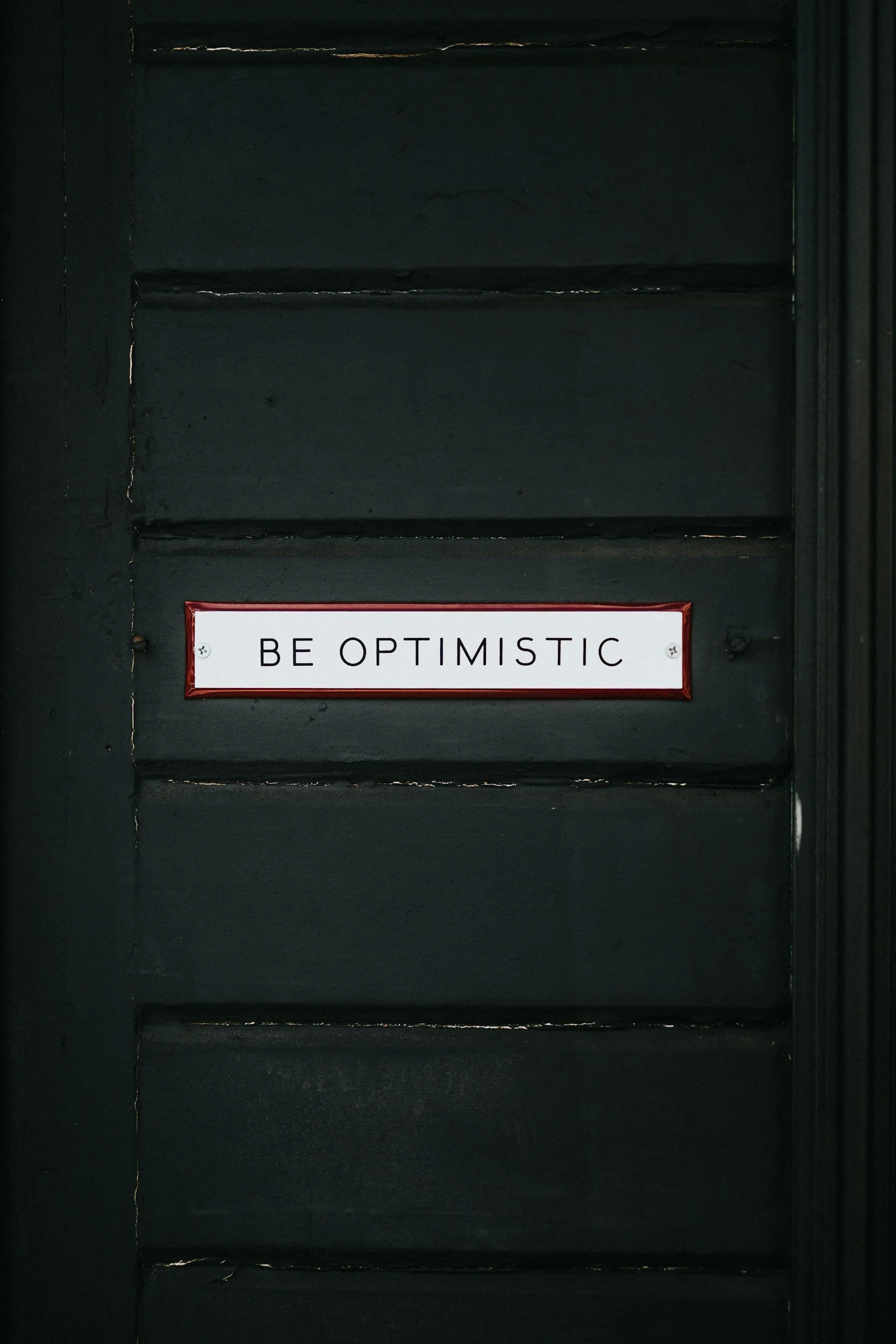
If your team is behind late in the game, there's still a chance. So you keep playing hard (if there's no chance, you might fold). If your bank account is not where you want it to be, there's still a way to earn (if the market is f*ed, why try?). And if you haven't found that special someone yet, believing that there is a good fit for you out there can positively impact conversations with attractive strangers.
It's not always easy. On tough days, being optimistic might be one of the biggest challenges you face all day. It's even more important on the dark days. So if you're willing to try, here are a few essential concepts to keep in mind.
Expectations Influence Experience
Two people can (and will) experience the same objective situation differently. It goes beyond personal preferences. Expectations shape perception by influencing predictive processing in the brain, leading individuals to experience the world in ways that align with anticipatory beliefs (Clark, 2013). The expectations we bring into situations can color those situations in a real, measurable way.
A study out of the University of Oxford demonstrated the ability of mindset, in the form of guided preconceptions, to change the way people respond to the same objective experience.
Researchers provided participants with taste stimuli and measured their brain activity while manipulating how the flavors were described. What they didn't change was the underlying taste stimulus.
In one condition, researchers used descriptions that emphasized the appealing qualities of the flavor. In another, the descriptions were less appealing. Expectations had been set. But remember, the underlying stimulus was the same.
The more appealing descriptions influenced participants' subjective ratings of pleasantness. But what the researchers found went beyond psychological suggestion. There were quantifiable neurological differences associated with the descriptions. Activity in brain regions involved in representing the pleasantness of food changed according to the language used, even though the taste stimulus had not changed (Grabenhorst et al., 2008).
The way the food was described changed participants' expectations and, measurably, their experience of enjoyment.
If the expectations we bring to a moment impact the moment, we should stay in tune with how we describe situations. That self-talk influences the way we engage with our environment. "Steve in accounting is always so difficult" will impact the way we engage with Steve. And "Carol just doesn't like me" will impact future interactions with Carol.
Situation by situation, try to use optimism as your primary filter.
Optimism Is Connected to Resilience
Did you know that they teach workshops on optimism to the U.S. Army? Think about that. If you are face down in the sand somewhere, and the enemy is upon you, believing that your actions can still make a difference may fuel your willingness to continue forward. There is courage, absolutely. There is toughness and a steadfast commitment to mission. There is grit and resilience. And they can all be supported by optimism.
Imagine a boxer getting up off the mat, bruised and beaten, but absolutely convinced that there is at least a chance, if he could just get up, step forward, and keep trying.
It is a quality shared by many of the highest performers of all time. It can be seen in companies that reinvent themselves through market shifts and economic downturns. They focus not on the trees, but on new paths through the forest, the new opportunities.
It can be seen in relationships that go the distance, wherein each partner is willing to engage with the hard stuff, to support the other through challenges, with optimism that, together, they can be stronger on the other side.
Research in affective neuroscience identifies important regulatory relationships between regions of the prefrontal cortex and emotion-related structures, including the amygdala (Etkin et al., 2011). These systems contribute to our ability to regulate emotional responses to stressful experiences, an important component of psychological resilience. Although this research does not establish that optimistic individuals necessarily have stronger regulatory pathways, it helps explain the neurological processes involved in managing adversity.

Martin Seligman's work with the U.S. Army's Comprehensive Soldier Fitness program helped establish an approach to resilience training that included cognitive skills rooted in learned optimism. The program was designed to strengthen psychological resilience, improve responses to adversity, and promote positive functioning under stressful conditions (Cornum et al., 2011). While the program's design does not itself establish the effectiveness of every intervention, it reflects an important recognition that resilience-related skills can be intentionally developed.
Optimism is not simply a soft trait. It is a mindset that can support psychological endurance in high-pressure environments. Even tough guys, especially tough guys, have reason to work on developing optimism.
Optimism Is Not the Enemy of Realism
Believe it or not, in the greater discussion of performance, this is a spot where people will occasionally push back. They will say things like, "I'm not an optimist, I'm a realist." Fair enough. There's a real world out there. And it can be tough. That's true. But optimism is not the enemy of realism.
You can, of course, be realistic and optimistic. If you spill coffee on your work, maintaining optimism does not mean you will be pleased with the stain. It means that you believe you can successfully navigate the situation.
Imagine two potential thought pathways in the spilled coffee example:
Through a pessimistic lens, one's thoughts might go to the cost of the shirt, wasted, convinced that there's no way to get the stain out; this might make you late to a meeting. What a shitty way to start the day; I'm such a klutz.
Through an optimistic lens, thoughts might include the idea that well, that's too bad. You might still wonder if the stain will come out, but thoughts trend toward solutions. I'll toss this in the wash and grab the blue shirt from the closet; if I'm behind, I'll send a message to the folks in my meeting, hope they understand; I can figure this out.
Optimism requires believing that, despite the real situation, there may still be options. There's still a chance. Maximizing your ability to adapt and making the most of whatever chances are available (the paths through the trees) hinges, in part, on optimism.
Of course, optimism can become a problem when it interferes with accurate judgment. Research on optimism bias suggests that people sometimes overestimate the likelihood of positive outcomes and underestimate potential risks (Sharot, 2011). That's where realism becomes essential. We need to recognize the obstacles in front of us, even as we look for a way through.
Moving Forward in a Threat-Centered World
Your brain appears predisposed to detect and prioritize threats, a tendency sometimes called the "negativity bias." Negative events can have a disproportionately greater psychological impact than positive ones, which researchers interpret, in part, as a survival-relevant feature: paying more attention to "bad" than "good" would have helped our ancestors spot danger and survive (Baumeister et al., 2001; Cacioppo & Gardner, 1999).
This has a neurobiological basis, as brain systems involving the amygdala contribute to detecting and responding to potentially threatening stimuli (Etkin et al., 2011). These systems can influence our responses even when a situation does not involve immediate physical danger.
Although we are no longer living in the Pleistocene, our brains continue to prioritize threat-related information. Yet research suggests that positive emotions can broaden our attention and expand the range of thoughts and actions available to us (Fredrickson, 2001). Deliberately shifting attention toward what is going well and what remains possible may help us recognize opportunities that would otherwise go unnoticed.
With consistent practice, orienting toward opportunity rather than remaining fixated on threat can become a useful strategy for supporting well-being and effective action.
It's natural. But to a degree, it's optional. Choose the optimistic option. Even when the cards seem stacked against us, optimism might be exactly what we need, if only to reshuffle the deck, or give ourselves the best chance to play the hand we've been dealt to its greatest outcome.
References
Baumeister, R. F., Bratslavsky, E., Finkenauer, C., & Vohs, K. D. (2001). Bad is stronger than good. Review of General Psychology, 5(4), 323–370. https://doi.org/10.1037/1089-2680.5.4.323
Cacioppo, J. T., & Gardner, W. L. (1999). Emotion. Annual Review of Psychology, 50, 191–214. https://doi.org/10.1146/annurev.psych.50.1.191
Clark, A. (2013). Whatever next? Predictive brains, situated agents, and the future of cognitive science. Behavioral and Brain Sciences, 36(3), 181–204. https://doi.org/10.1017/S0140525X12000477
Cornum, R., Matthews, M. D., & Seligman, M. E. P. (2011). Comprehensive soldier fitness: Building resilience in a challenging institutional context. American Psychologist, 66(1), 4–9. https://doi.org/10.1037/a0021420
Etkin, A., Egner, T., & Kalisch, R. (2011). Emotional processing in anterior cingulate and medial prefrontal cortex. Trends in Cognitive Sciences, 15(2), 85–93. https://doi.org/10.1016/j.tics.2010.11.004
Fredrickson, B. L. (2001). The role of positive emotions in positive psychology: The broaden-and-build theory of positive emotions. American Psychologist, 56(3), 218–226. https://doi.org/10.1037/0003-066X.56.3.218
Grabenhorst, F., Rolls, E. T., & Bilderbeck, A. (2008). How cognition modulates affective responses to taste and flavor: Top-down influences on the orbitofrontal and pregenual cingulate cortices. Cerebral Cortex, 18(7), 1549–1559. https://doi.org/10.1093/cercor/bhm185
Sharot, T. (2011). The optimism bias. Current Biology, 21(23), R941–R945. https://doi.org/10.1016/j.cub.2011.10.030
It is a quality shared by the highest performers of all time. It can be seen in companies that reinvent themselves through market shifts and economic downturns. They focus not on the trees, but new paths through the forest, the new opportunities.
It can be seen in relationships that go the distance, wherein each partner is willing to engage with the hard stuff, to support the other through challenges, with complete optimism that, together, they will be stronger on the other side.
Studies in affective neuroscience reveal that optimistic individuals recover more quickly from stress due to stronger regulatory pathways between the prefrontal cortex and emotion centers like the amygdala (Etkin et al., 2011). This enhanced recovery pattern is a defining component of psychological resilience.
Martin Seligman’s work with the U.S. Army’s Comprehensive Soldier Fitness program demonstrated that teaching cognitive skills rooted in learned optimism significantly improved soldiers’ resilience, emotional regulation, and stress recovery (Seligman et al., 2011). The program’s findings show that optimism is not a soft trait but a measurable protective factor that strengthens psychological endurance in high-pressure environments. Even tough guys – especially tough guys – work on developing optimism.
Optimism is not the enemy of realism.
Believe it or not, in the greater discussion of performance, this is a spot where people will occasionally push back. They will say things like, “I’m not an optimist, I’m a realist.” Fair enough. There’s a real world out there. And it can be tough. That’s true. But optimism is not the enemy of realism.
You can of course be realistic and optimistic. If you spill coffee on your work, maintaining optimism does not mean you will be pleased with the stain. It means that you believe that you can successfully pilot the situation. Imagine two potential thought pathways in the spilled coffee example:
Through a pessimistic lens, one’s thoughts might go to the cost of the shirt, wasted, convinced that there’s no way to get the stain out; this might make you late to a meeting, what a s*itty way to start the day; I’m such a clutz.
Through an optimistic lens, thoughts might include the idea that “well, that’s too bad.” You might still wonder if the stain will come out, but thoughts trend toward solutions – I’ll toss this in the wash and grab the blue shirt from the closet; if I’m behind, I’ll send a message to the folks in my meeting, hope they understand; I can figure this out.
Optimism requires believing that, despite the real situation, there are always options. There’s always a chance. Maximizing your ability to adapt and maximizing what chances are available (the paths through the trees) hinges, in part, on optimism.
Moving Forward in a threat-centered world.
Your brain appears predisposed to detect and prioritize threats, a tendency sometimes called the “negativity bias.” Negative events have a disproportionately greater psychological impact than equally intense positive ones, which researchers interpret as a survival-relevant feature: paying more attention to “bad” than “good” would have helped ancestors spot danger and survive (Baumeister et al., 2001; Cacioppo & Gardner, 1999).This a neurobiological event, as circuits centered on the amygdala appear to selectively prioritize threat-related stimuli, making the brain especially sensitive to cues of danger, even when there is no immediate risk (Shackman, 2019).
Although we are no longer living in the Pleistocene, our brains continue to privilege threat-based information, yet studies show that deliberately shifting attention toward what is going well and what is possible can reshape subjective experience and improve overall well-being (Fredrickson, 2001). With consistent practice, orienting toward opportunity rather than threat becomes one of the most reliable pathways to greater happiness.
It's natural. But to a degree, it’s optional. Choose the optimistic option. Even when the cards seem stacked against us, optimism might be exactly what we need, if only to reshuffle the deck, or give ourselves the best chance to play the hand we’ve been dealt to its greatest outcome.